The Gamestop Phenomenon: A Case Study in "Fake News"
This story is part of a multi-part segment on trust in the media


As of the time of this writing, GameStop’s stock has taken headlines due to its insane volatility, rising from nearly $4 last July to nearly $450 in late January, before plunging down to $64 now in early February.
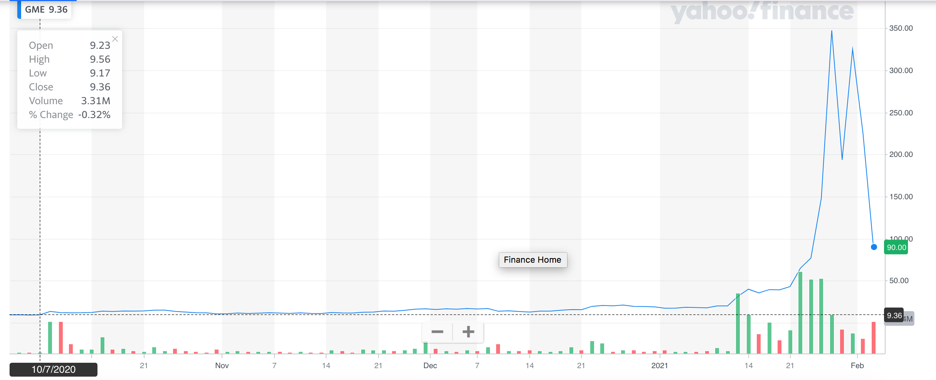
What makes Gamestop different from other volatile stocks is that the traders supposedly behind the volatility are retail investors primarily from the community “WallStreetBets” on the social media site Reddit. WallStreetBets traders have historically specialized in making risky bets on stocks, however, this is the first time their trades have taken fire and the first-time retail investors have had such an impact on a stock’s price. On the losing end of the trades were large hedge funds, specifically Melvin Capital, who had taken a large bet against the price of the stock.
There is a lot we can learn from the rise and fall of Gamestop’s stock. One lesson that we can all take away from it is the clear creation and impact of fake news, and how quickly it spread.
Trust in mainstream media is at an al
l-time low according a recent Gallup poll, with roughly 50% of Americans having little to no trust in mainstream media.
This comes from both sides of the aisle, with criticism of the misinformation coming from both those on the left and the right (Trump’s favorite phrase is “fake news”). Recently, private platforms such as Twitter and Facebook have taken action to ban public figures who have violated their terms and conditions, a move that has demonstrated the immense power private entities have to control key communication channels.
It makes sense why the media plays a major role in society. As someone with a 9-5 job, I do not have the time to do my own investigative reporting, nor do I have the time to obtain the specific knowledge to understand the intricacies of incredibly complex fields such as economics, medicine, finance, immunology, etc. The media plays an incredibly important role in breaking down complex and technical events in a way that I can understand, allowing me to make an informed decision on a variety of personally relevant issues.
This is why the rise of fake news has been so damaging: if we cannot trust news networks, social media, nor experts, then who do we trust? If we just trust ourselves and the people close to us, we are going to be making uninformed decisions based almost entirely on gut feeling and an echo chamber of opinions.
There’s a lot to write about concerning the importance of media, the rise of fake news, and possible solutions to boost trust in the media. This article will be part of a multipart series about the role of media in society, incentive structure problems in how media is published, and possible solutions. However, for now, I want to cover three major areas where media was used to manipulate market sentiment to benefit short-sellers of Gamestop.
Major News Networks Sowing Deceit
On Monday January 31, after a drop from $345 at close on Thursday to $197.44 at market close on Friday, major news networks such as CNBC, CNN, and the WSJ picked up that WallStreetBets on Reddit was targeting silver next. This story was almost entirely false, and can be confirmed by a simple search of WallStreetBets.

I do not think every major news network was intentionally pushing fake stories, I think it is more likely that major news networks share/take stories from each other. However, I think there are a few conclusions from this:
Any major network that picked up this story is guilty of at least extremely lazy reporting. Two clicks could have taken them to the source and confirmed that the story was false. This is surprising, as it would seem to be benefit for major networks to deliver truth when other networks are perpetuating fake news. Apparently due diligence isn’t rewarded enough to actually do that.
Someone at some point originated the story, and whichever network actually originated the story purposely engaged in false reporting or has a source that intentionally deceived them
This lazy reporting goes to even news networks that are generally considered high-quality and have a paid subscription (WSJ). Some networks eventually reported that Reddit was not the driver of the silver surge, such as Bloomberg, but these articles came out much later then the originals.
Bots/ Plants Sowing Fear and Doubt on WallStreetBets
Astroturfing is not a new concept. Culturally, people are going to buy something from someone who has no clear link or motivation to promote a product other than they like it. The same is true for any “grassroots” effort, of which the WallStreetBets community is a key driver of. For Gamestop especially, it seems clear from social media and mainstream media that WallStreetBets was a key driver around the positive sentiment associated with Gamestop. Thus, it makes sense for those who are short to try to infiltrate the community directly and actively change sentiment.
Multiple users on WallStreetBets have posted evidence of a number of spammers and bots telling users to sell, much of which has been deleted.
However, some evidence still exists, including from this thread, where the user shows someone making 100s of comments encouraging WallStreetBets users to sell their positions.
Recent moderator changes to WallStreetBets (as of February 4) has meant that the sub hasn’t been effectively moderated for a period of time, leading to complaints from users that the amount of spam and shills has increased exponentially.
Further, due to the large amount of spam, WallStreetBets mods have made changes to the AutoModerater, including not allowing people to post who were copying and pasting as well as not allowing people to post with low karma to post.
Finally, users on the WallStreetBets subreddit acknowledge the misinformation to the extent that they’ve created memes out of it.
The conclusion seems to be that some individuals are trying to infiltrate the sub and induce people to sell their positions, representing manipulation via social media in an attempt to benefit short sellers.
Hedge Funds Saying They Covered
To understand why hedge funds saying they have covered is a big deal, it is important to first understand what a hedge fund is and how they work. A hedge fund is functionally an investment vehicle that’s accessible only to the super wealthy. Different hedge funds have different strategies and goals, but generally speaking they’re going to try to deliver a superior investment performance vs. the general market, less risk, etc. Their fee structure, while different between funds, is typically 2/20, meaning 2% of the money you invest with them is paid as a fee annually, and 20% of all gains are paid as fees. This is extremely high compared to annualized fees of 0.05% on some passive index funds.
To justify these high fees, hedge funds need to add clear value, and they usually try to do this via complex, proprietary strategies. Hedge funds do not typically disclose their strategies, so why are they disclosing to the media that they’ve closed their shorts?This is also true of other short-sellers, such as Andrew Left of Citron research.
Keep in mind that neither the hedge funds nor Citron research have any obligation to report their short positions via the news, and they do not typically. So why are they reporting it now? There could be more benign explanations, such as to reassure potential investors (does that reassure them?), but it could also be false reporting to manipulate market sentiment.
Directly From the Hedge fund Playbook
In a rare interview, Jim Cramer, a former hedge fund manager and host of CNBC’s Mad Money, admits that hedge funds use the above tactics to manipulate stock market prices. While the original interview with TheStreet.com has been taken down from YouTube in recent days for copyright infringement, a Thomas Reuters article from 2007 includes a damning direct quote that are applicable to the situation above:
"Then you call the (Wall Street) Journal and get the bozo reporter in Research in Motion and you would feed that (rival) Palm's PALM.O got a killer it's going to give away," he said. "These are all the things that you must do on a day like today and if you're not doing it, maybe you shouldn't be in the game."
This quote from Cramer explains the above tactics of manipulating the news and consumer sentiment have been used by hedge funds before. There’s no reason to believe that they’ve changed, especially given the weak nature of the SEC.
The Importance of the Above
Access to high-quality, digestible information is important to all of us. The rise of “fake news” is causing record-breaking distrust in the media, and the above three instances are examples of potential “fake news” being pumped out by short-sellers of Gamestop to manipulate market sentiment for their personal financial gain. This is the first part of a multi-part series of increasing distrust in media in the United States, including other relevant examples, the negative impact on American society, and possible solutions.